“See the mountain ahead?” Marco asks. Yes, I do. “Look at the very top, just below that cloud on the left, do you see that temple?” He guides my eyes toward it. I squint, searching for what he wants me to see. Then I find it. “Yes, I see it,” I say. “Well, we’re going to hike up to that temple,” he says. “Sure we will,” I reply, sarcastic, assuming he’s pulling my leg.
He wasn’t.
I said yes before I understood what I was actually agreeing to. Not just a hike. Almost two hours straight up a mountain, five months after my divorce, in a body I hadn’t checked in on in longer than I want to admit.
I didn’t know it yet, but that hike to Tepozteco temple in Tepoztlan, Mexico, was about to make my body answer questions my mind had been avoiding for a long time.
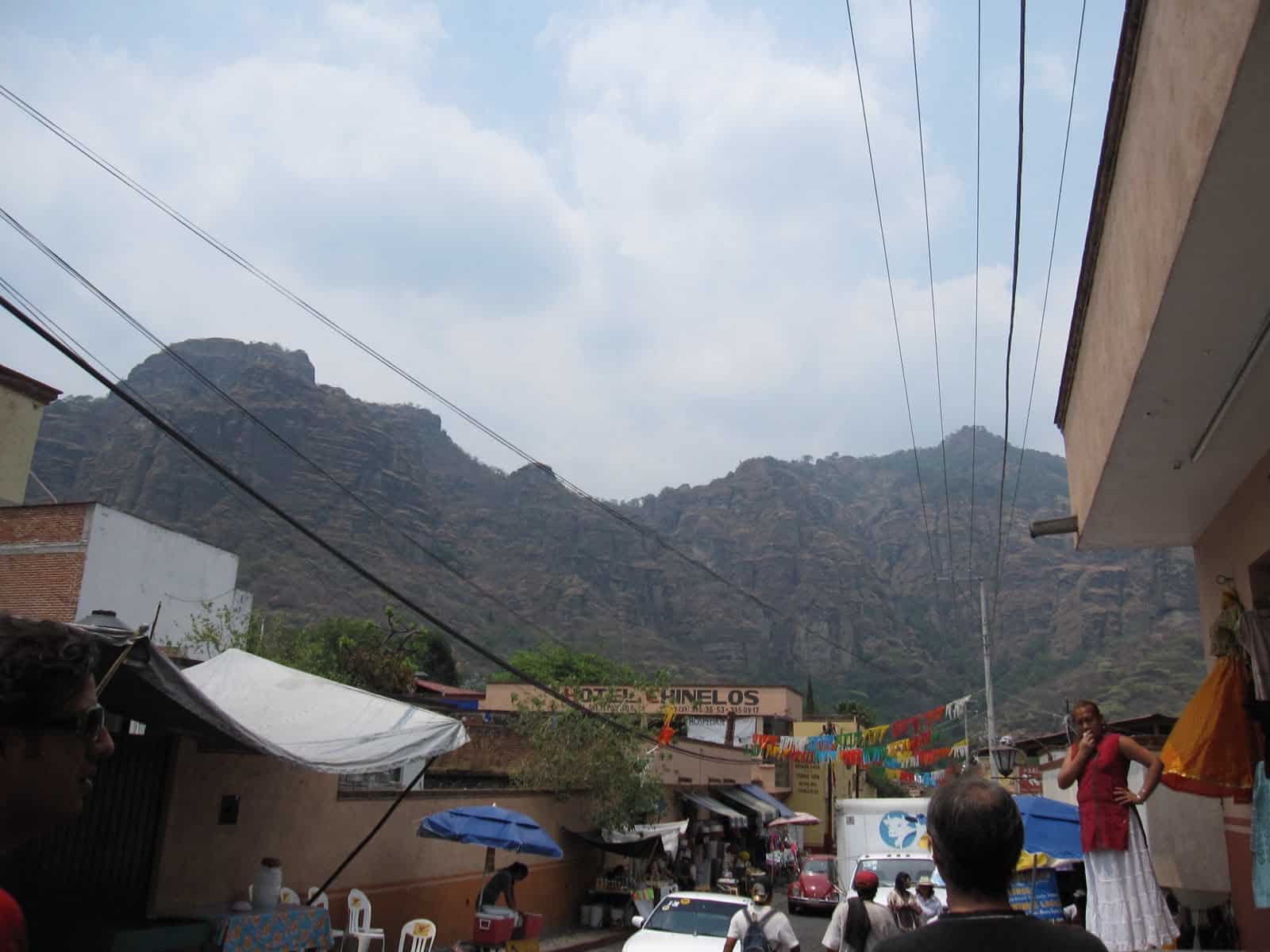
The mountain, from the street. It looked further away than it was, which turned out to be the least of my problems.
What I Didn’t Notice I Was Losing (The Body’s Toll After Divorce)
Here’s what my life looked like in the months after my divorce. My idea of exercise was walking down to the home theater in my building, an actual cinema room with rows of deep armchairs, built for exactly the kind of disappearing I was doing most nights.
There was a small grocery store downstairs too, a fancy 7-Eleven, I’ve long since forgotten its name, and I’d stop there on the way down for snacks I didn’t need before watching a movie I’d usually already seen.
My idea of a marathon was multiple episodes of CSI back to back. My workload was too much, I had just gone through divorce and somewhere in the middle of it I stopped having time for the gym.
Exercise fell to the bottom of a list and for months it barely made the list at all. I was letting myself go, quietly, without ever deciding to.
There was one exception. I had left the sanctuary my friend had offered and moved into a condo on the 36th floor, no curtains yet, so I woke every morning to an early Toronto sunrise, the CN Tower on one side, Lake Ontario stretching out on the other.
That view was the only thing that still made me want to get out of bed and do something with my day. Not hope exactly. More like proof that I was in transition, even if I had no idea yet what I was transitioning toward.
That’s the part nobody warns you about. Divorce doesn’t announce itself in your body all at once. It shows up as a missed gym membership, a mirror you stop looking into, the small permissions you quietly stop giving yourself.
If you’re a woman in the UAE or the wider Arab world going through this, that erosion tends to happen with even less witness than mine did. Fewer people checking in. Less room to look like you’re not fine.
The body still keeps the score. Mine did, quietly, for months, before a mountain forced me to count it.
Everyone Around Me Was Vibrant, I Was the Opposite (Signs I Couldn’t See in Myself)
Five of us climb, straight up, for almost two hours. I am the youngest of the group, thirty-five, and by far the least fit.
I am gasping within the first twenty minutes and I don’t stop. Every few minutes I pull over to catch my breath, drink water, steady myself, and every time, the same thought circles back: why did I say yes to this.
One of the people in the group is a fifty years old man, and he moves up that mountain like it’s a stroll in the park. I am thirty-five and it feels like I am climbing Mount Everest.
Marco was the one who had invited me to Mexico in the first place, so in a way he was my host on that mountain too. He kept going back and forth between the friends who were climbing fast and me, dropping back to check on me, then catching up to them, then dropping back again. Without breaking a sweat!
Every time he reached me he said the same thing: “Let it go, and you’ll feel better. Let it go, just let it go.” He said it so many times I lost count.
I didn’t understand him. Not yet. I was too deep in my own story, how unfit I was, how humiliating this was, running through every version of quitting I could think of.
Okay, I’m going back to the car.
Except I didn’t know the way back to the car. I was somewhere in the middle of a mountain with no path I recognized in either direction, which meant the only real option, even inside my self-pity, was forward.
So I tried. Not because I understood what he meant, but because I didn’t have anything else. With every breath, I repeated fragments of his sentence back to myself.
Let go. Okay, let go. Shed it. Let it. I’ll feel lighter. I wasn’t making sense of it yet, I was just trying the words on, the way you repeat a word in a foreign language before you know what it means.
That comparison, the shame of being the one who couldn’t keep up, was information, not really about fitness at all. My body was carrying months of holding myself together in public while quietly falling apart everywhere else.
That instinct doesn’t disappear after divorce, it often gets stronger, especially for women who feel they have to look composed, unaffected, like none of it is touching them.
The version of yourself that’s allowed to struggle in front of people gets smaller and smaller, until a mountain is the only place left where it can’t be hidden anymore.
The Boulder Where I Stopped Pretending I Was Fine (When the Body Forces What the Mind Avoids)
By now, I’ve convinced myself the end is close. It isn’t. I look up and see only a crack between two peaks, higher than where I’m already standing, no summit in sight, no way of knowing how much further this goes.
Something in me gives out. I sit down on a boulder, still warm from the sun, and I cry.
I cry because I want to be done.
I cry because turning back feels like its own kind of shame, a second failure stacked on the first.
I cry because I can’t see an end, only more mountain.
But underneath the shame was something with more weight to it. I was grieving. Grieving the version of me that existed before that marriage, the one who took care of her body without having to think about it.
Grieving two and a half years spent inside something that was never supposed to happen in the first place, years I couldn’t get back no matter how far up this mountain I climbed. And somewhere underneath even that, one more voice, less honest than the grief, unhelpful the way shame always is: look how pathetic you’ve become.
This is the longest break of the entire hike.
That boulder gave me something no one around me had been giving me permission for: a place to stop pretending. It was the first honest moment I’d had in months, not composed, not managing anyone’s perception of me, just collapsed and real.
Grief surfaced first, and grief deserves space, mourning who you were and what you lost is the cost of having lived through something real. Shame surfaced too, quieter but just as present, and shame rarely tells the truth, it just makes loss heavier than it already is.
Not every woman gets a boulder to tell the two apart. For many women carrying a divorce quietly, especially under the stigma that still follows divorced women across the Arab world, there’s no mountain far enough from home to fall apart on.
The performance doesn’t get a break. So the body ends up finding smaller, harder ways to force the same stop, a health scare, an exhaustion that won’t lift, a body that simply refuses, one ordinary morning, to get out of bed.
How the Body Releases Stress, Step by Step
Let it go, let it go, let it all go. The words won’t stop circling.
I think of my friends already at the temple, waiting, probably passing around something cold to drink, and some old competitive instinct kicks in underneath the grief, I have to get there too.
So I stand up, and I decide that every remaining step will be a kind of surrender instead of a fight.
Let go of the past.
Let go of the marriage that had already failed long before I admitted it.
Let go of the long hours of work I used to avoid feeling anything.
Let go of a life that gave me everything except the sense that it was mine.
Let go of ignoring this body for so long it had to force me onto a boulder to be noticed.
Let go of the shape I’d let myself become, and the shame about that shape, both at once.
Let go of what anyone watching might think.
Let it all go, one step at a time, because that’s the only pace at which letting go is actually possible.
When I reach the top, the rest of the group is already there, and they cheer like I’ve crossed a finish line at some race instead of just finally arriving. No mojitos, it turns out. Just something cold and sweet, lemonade or close enough, and I drink mine in seconds.
The temple itself is mostly ruins by now, stone worn down by centuries, nothing dramatic to look at up close. But it isn’t really about the temple.
It’s about what surrounds it. From up there, the view goes the full circle, three hundred and sixty degrees of it, and wherever I turn, it’s the same glorious green, and more green, folding into itself as far as I can see under the clear blue sky.
After two hours of gasping and crying and talking myself through every single step, this is what was waiting: relief.
Nature has always been the better teacher on this point than I’ve ever been with myself. There’s a time for the climbing, the effort, the gasping.
Then, without much warning, a time to just stop and let a view do what it’s there to do. Marco’s breathing meditation session, afterward, only made the lesson land harder.
He gives us sounds to make, not words, not a song we sing so much as one we follow, long open vowels he guides us through one at a time, and we let them out toward the rock face in front of us until they come back changed, layered over themselves, filling the whole clearing.
I don’t have a better way to describe what that does to me except that somewhere in the echo of my own voice, something in my chest loosens.
That is the moment the whole lesson finally lands, later than it should have, but it lands. Getting through the hardest parts of anything doesn’t always take more effort.
Sometimes it takes exactly the opposite. Sometimes it’s just letting go.
None of it happened in one motion. The mantra had to repeat itself for nearly two hours before it worked.
The sounds at the temple didn’t undo the marriage or the months of self-neglect in a single echo either. Letting go works the way a long, slow exhale works, one step, one sound, one small release at a time.
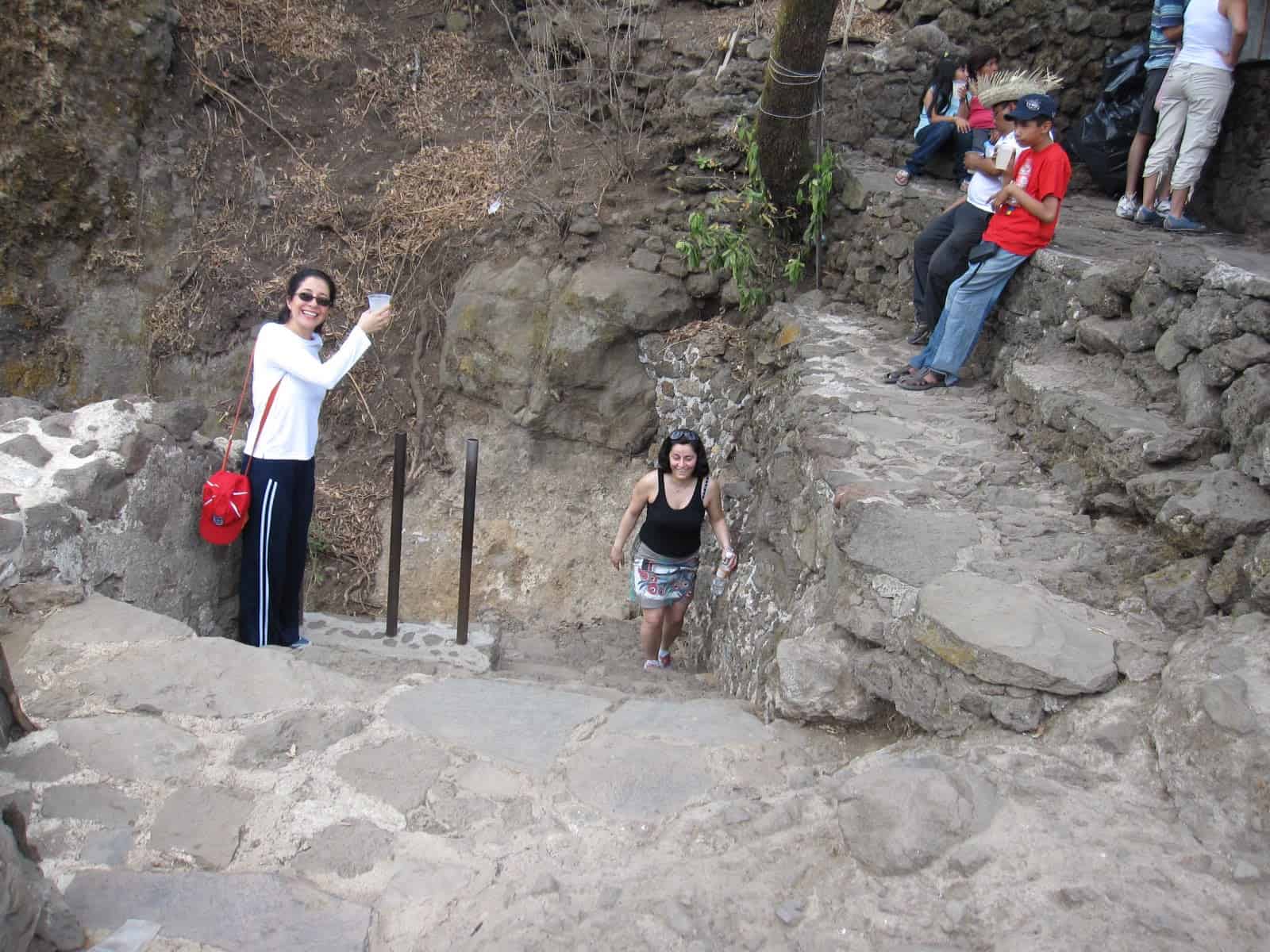
Starting Over After Divorce: What Is Your Body Trying to Tell You?
Back home in Canada, one of the first things I did was stop going to the home theater in my building.
I ditched it, and instead I went to find the gym. I started showing up almost every day.
If you’re somewhere in your own version of this, here are a few questions worth sitting with.
What have you been carrying that you haven’t actually looked at yet?
What would you need to let go of to feel lighter the moment you put it down?
Have you had your own boulder, your own forced stop, or are you still waiting for permission to have one?
What’s the mountain you keep putting off climbing, and what is it, really, that’s stopping you?
If any of these questions land harder than you expected, that’s exactly the work I sit with women through privately, one container at a time.
Book a free discovery call and let’s find out what you’re actually ready to let go.